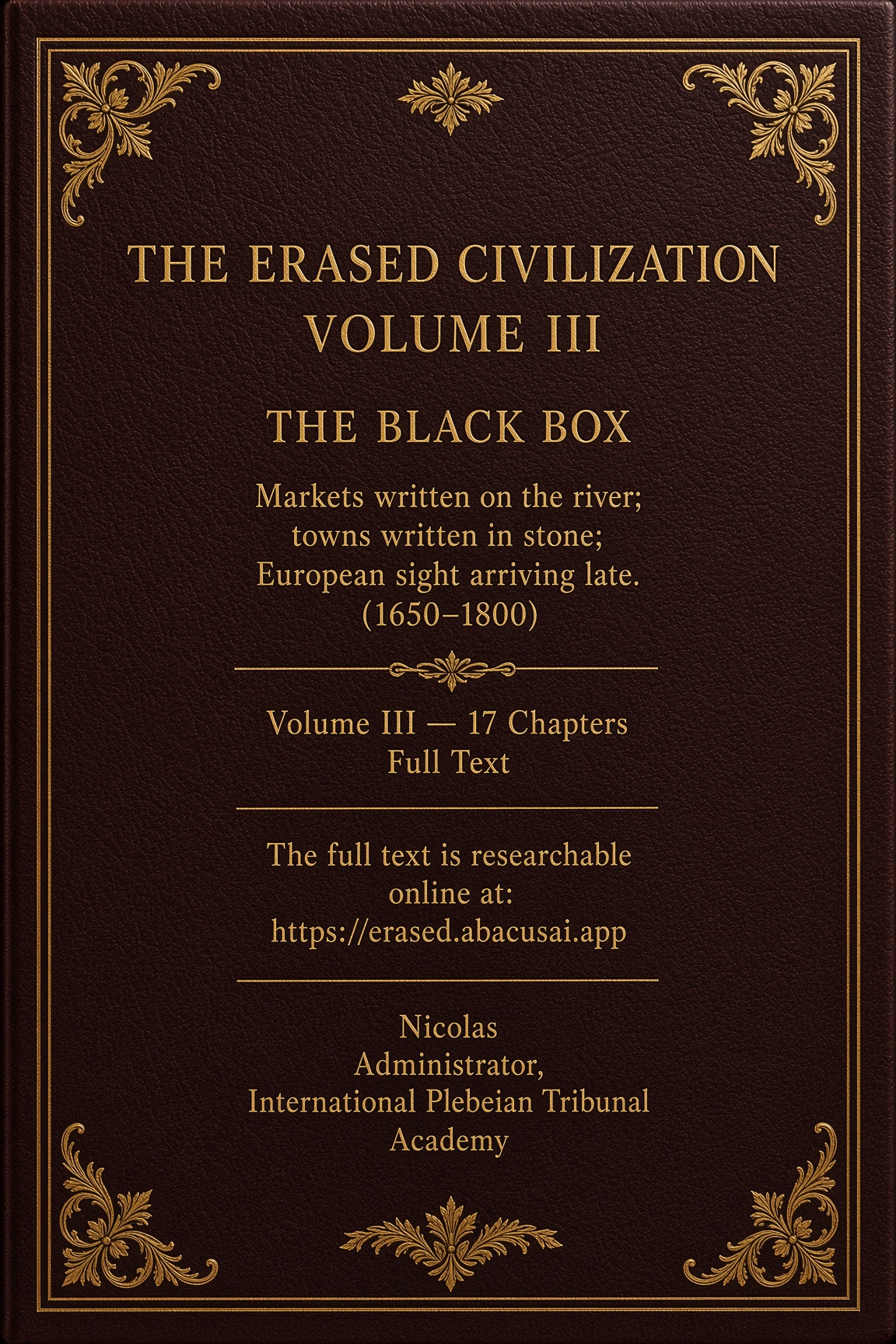
THE ERASED CIVILIZATION VOLUME III
THE BLACK BOX (1650–1800)
Description
This volume covers 1650–1800, with controlled overruns: the 1629 Mutapa treaty that frames the fiscal inversion; Campbell and Kay in 1820–21, who first walk Kaditshwene; Thulamela and Mapungubwe as reception of earlier states; Farini in 1885 as a control case of invented stone. Each overrun is labelled in the chapter that uses it.
The book has three parts.
Part I reads the European files that do exist — VOC inland paper, the first British occupation (WO 1, not CO 48), early LMS journals — and states what they do not contain.
Part II reads the stone: Kaditshwene, Marothodi, Molokwane, Bokoni, then Mapungubwe/Thulamela as twentieth-century knowledge politics, and the Kalahari “lost city” as geology plus desire.
Part III reads the Cuama system: river nodes, feiras, kuruva and empata, the 1629 paper, Dombo’s war, Conceição, Dambarare’s churchyard, Zumbo, the Jesuit–Dominican–Augustinian split, and the 1759 cut.
File Information
THE_ERASED_CIVILIZATION_VOLUME_III.pdf
application/pdf • 1.7 MB
About the AuthorView Full Profile
Nicolas Brett
Nicolas Brett is a South African author and researcher whose work explores loyalty, suppressed truths, and the human cost of silence. Drawing on his background as an entrepreneur and tribunal administrator, he blends authentic grit with literary depth. His debut novella Unopened examines brotherhood, war, and hidden love, bringing raw realism and emotional resonance to themes of identity, memory, and legacy. Brett’s voice bridges lived experience with universal reflection.
Read Portions of the Book Online Below
Browse the first 20% of this book — ... pages available
Loading book reader...
📱 eBook (Digital)
Instant download after purchase. Read on computer, tablet, phone or e-reader. DRM-free PDF/EPUB format.
R350.00
Secure payment via Yoco
Need this book in another language?
Request a translation and we'll contact you with availability and pricing.
Reviews (0)
No reviews yet.